
The 2026 State-by-State Guide to Financial Literacy Requirements
Is your student's high school education keeping up with the rest of the country? At Supercharged Science and Math, we’ve kept up with the latest mandates and developed a Personal Finance course that more than satisfies the requirements while ensuring your student gains real-world mastery. As of March 2026, 39 states now require personal finance education in some form, but the way they teach it varies significantly.
Source: Council for Economic Education: Survey of the States
Here is the current breakdown of how each state handles financial education.
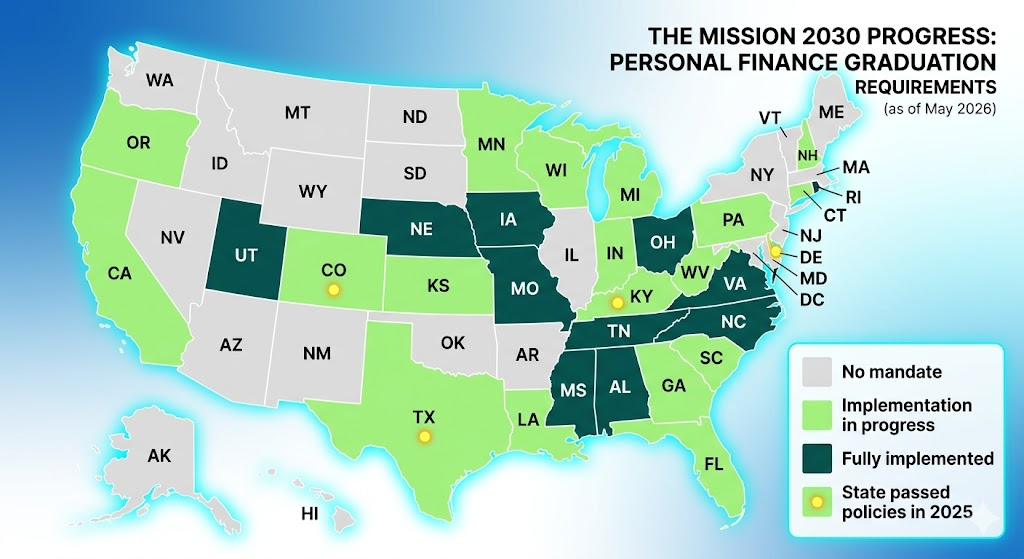
The "Standalone Course" States (30 States)
These states require a standalone, dedicated personal finance course (typically one semester). Once all 30 states have fully rolled out their requirements, over 70% of public high school students in America will be required to take a course in personal finance². This is the model we use for our Personal Finance and Business Math Curriculum, as it ensures students have enough time to actually master the concepts.
Source: Council for Economic Education: Policy & Advocacy
States Currently in effect
Alabama, Iowa, Mississippi, Missouri, Nebraska, North Carolina, Ohio, Rhode Island, Tennessee, Utah, Virginia,
First year when all Graduating Seniors must take Personal Finance:
2027
Connecticut, Florida, Kansas, Louisiana, New Hampshire, Oregon
2028
Georgia, Indiana, Michigan, Minnesota, South Carolina, West Virginia, Wisconsin
2030
Colorado, Delaware, Kentucky, Pennsylvania, Texas
2031
California
The "Integrated/Embedded" States (9 states)
In these states, personal finance is required, but it is often woven into other subjects such as Math, Social Studies, Economics, or other courses rather than being taught as a standalone class.
Arizona, Arkansas, Hawaii, Idaho, Montana, Nevada, New Mexico, New York, North Dakota
Important Note: Research consistently shows that embedding personal finance content into other courses does not produce measurable improvements in graduates' financial outcomes compared to standalone courses.
Source: FINRA Investor Education Foundation Research Center
States with No Mandatory Requirement (11 States)
As of mid-2026, these states still leave financial literacy largely up to local districts or elective choices. New York, New Jersey, Maryland, and Illinois are among the highly populated states without requirements²¹. For homeschoolers in these states, adding a personal finance credit can give your student a significant competitive advantage.
States without a requirement:
Alaska, Illinois, Maine, Maryland, Massachusetts, New Jersey, Oklahoma, South Dakota, Vermont, Washington, Wyoming
Does Your Curriculum Meet Your State's Standard?
Whether you live in a state with a standalone requirement, an integrated approach, or no requirement at all, our goal at Supercharged Science and Math is to ensure your student is prepared for the real world.
Our Applied Personal Finance Curriculum is designed to exceed the national standards, focusing on the mathematical logic behind wealth building, debt management, and economic independence. Even if your state doesn't require it, financial literacy is one of the most valuable skills your student can learn.
Learn More: Supercharged Science & Math