
Supercharged Science & Math Adventure Day has ended.
We hope to see you at our next event!

Supercharged Science Adventure Workbook
I’ve put together a special workbook for you to use as we go through our classes together!
Inside you’ll find space to take notes, record your results, and sketch out your big ideas for the science experiments.
You’ll also find a materials list to help you stay organized and ready when class starts. Keep this workbook with these materials so everything is together and ready to go!
Summer Science Camp Week Recordings & Challenges:
We'll cover three different topics. In each class, we have a challenge to complete, so make sure you keep up! Enjoy and have fun discovering, learning, and innovating!
Science Camp Week Recordings & Challenges:
Each day, we'll cover a different topic. We'll also have a new challenge to complete within a very short time, so make sure you stay on top of everything this week! Enjoy and have fun discovering, learning, and innovating!
Did you miss a class?
Below are replays for each day. These will remain up until the end of the week, so be sure to watch as soon as you can! (Some replays may not be available because the sessions are still in the future!)
Not yet registered for Supercharged Science & Math Adventure?
Science & Math Adventure Class Recordings
Recordings will be available until March 8, 2026
Chemical Reactions: 10am Pacific (1pm Eastern)
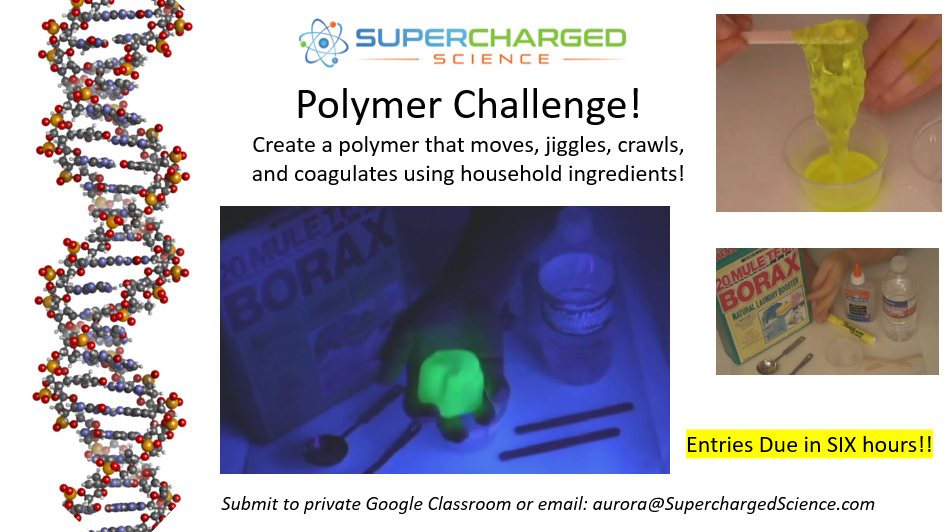
Polymer Challenge
Glowing Slime
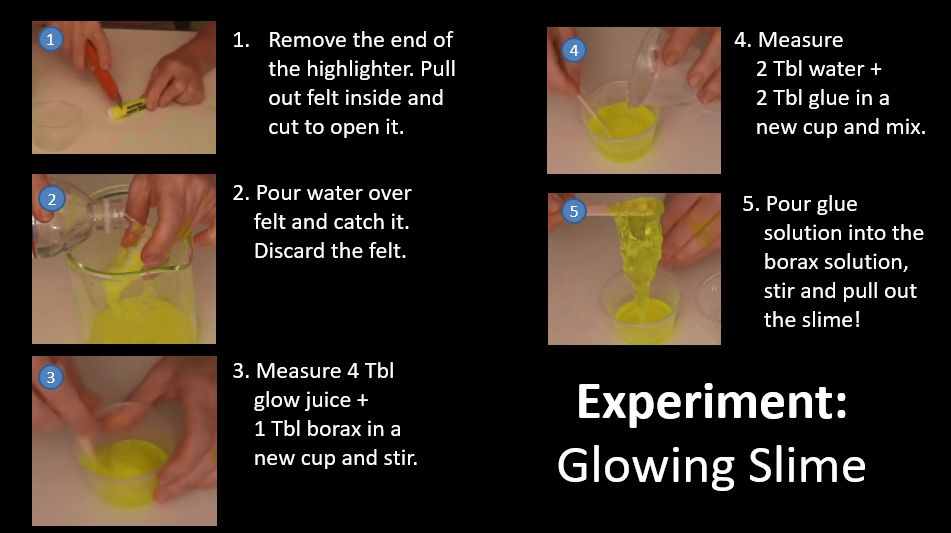
In this experiment, you’ll mix glue and borax to watch tiny particles link together and form a stretchy slime. This shows how chemistry can change a liquid into something new!
Puffy Slime
Shaving cream traps air inside the slime, making it puffy and soft. This shows how adding air can change how a material feels and behaves.
Sulfate Challenge
Bonus Crystal Experiments to do Tonight
In this experiment, sugar slowly comes out of solution and forms crystals as the water cools and evaporates. Crystal growth usually begins within a day or two and can take one to two weeks to reach full size.
If the solution isn’t saturated enough, or the stick touches the sides or bottom, or the container is disturbed, crystals may grow slowly, fall off, or clump instead of forming clear rock candy shapes.
If it's been a week and still no sign of crystals, reheat the solution and add more sugar, and this time, store in a warm location (like on a high shelf).
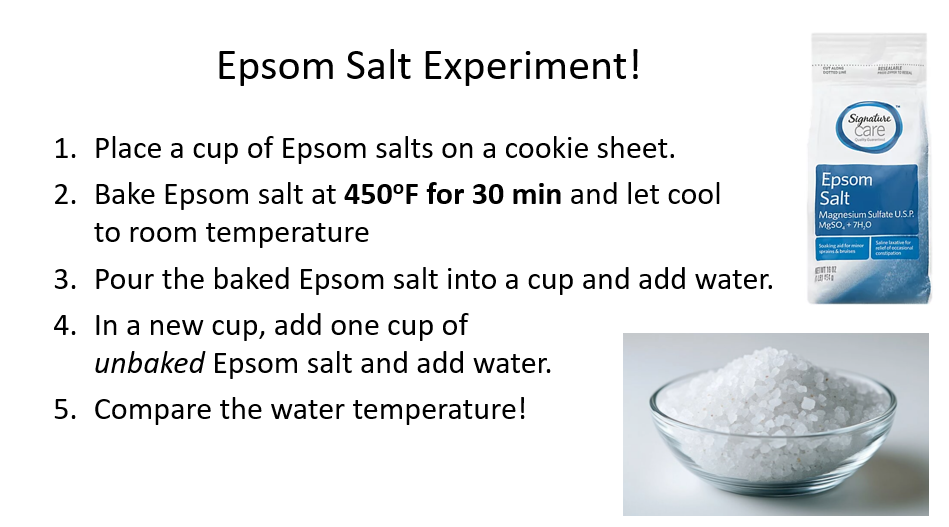
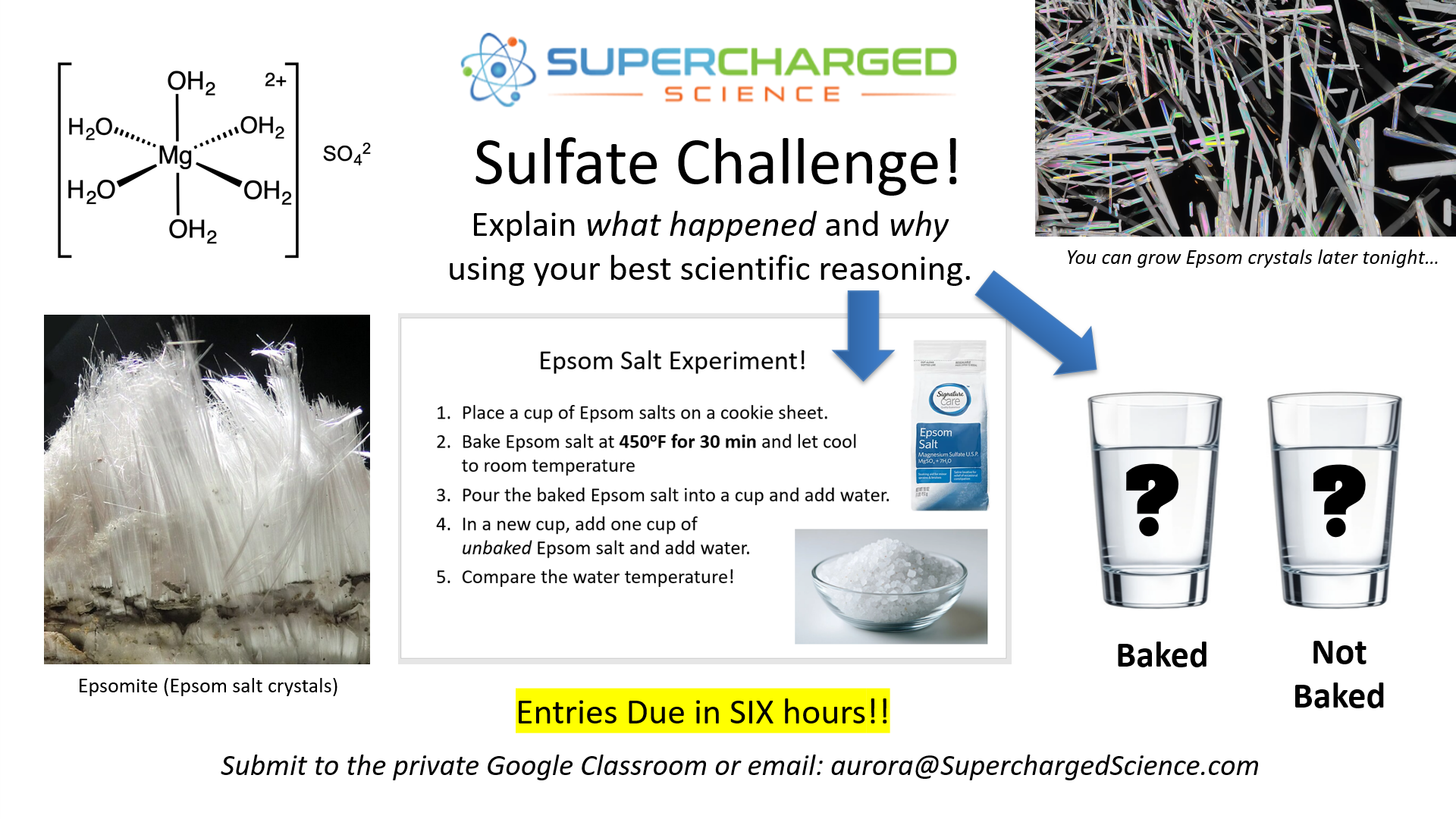
In this experiment, dissolved borax (laundry detergent) particles come back together as the solution cools and form crystals. You can substitute Epsom salts for borax to grow fast, feathery crystals instead of chunky ones.
Borax crystals usually start forming within 10–30 minutes and look best after a few hours or overnight, while Epsom salt crystals can appear in minutes and finish growing within 1–3 hours.
If the water isn’t hot enough, or the solution gets disturbed, or not enough powder is added, your crystals may not grow properly or turn into a cloudy mess instead of forming clear shapes.
In this experiment, salt crystals form as dissolved salt slowly comes out of solution while the water evaporates. When a string connects two glasses, the salt solution travels up the string and evaporates in the air, causing crystals to grow downward in the middle like a tiny stalactite. This happens because evaporation is fastest in the open air, pulling more solution along the string and leaving salt behind as it crystallizes.
In this experiment, salt dissolves in vinegar and then forms crystals as the liquid evaporates. The sponge soaks up the solution and provides many tiny spaces where crystals can start growing. As the vinegar evaporates, salt is left behind on the sponge, allowing crystals to grow in many directions instead of just one.
Secret Codes & Ciphers: 11am Pacific (2pm Eastern)
Supernovae & Black Holes: 5pm Pacific (8pm Eastern)
Supernovae are giant explosions where a star suddenly releases a huge amount of energy. This ball drop is a model of energy transfer: the big ball hits the ground and bounces, then it transfers energy to the small ball. Because the small ball has less mass, it shoots off fast. In a supernova, a lot of energy can push some of the star’s material outward at very high speeds.
When huge stars explode or collapse in space, they release energy and particles that travel across the universe. We can’t see those particles with our eyes, so we use a cloud chamber to see invisible particles by showing the tracks they leave behind. This project requires adult help. Make sure you do NOT seal the glass container (as it will shatter!) Please follow all instructions carefully.
You will need a cardboard tube, scissors, four ball bearings, and four neodymium magnets. This video above is the simpler version. If you prefer to make the expanded version, please watch the Gauss Linear Accelerator (right video).
This project shows how objects can be sped up step by step. Each magnet pulls the metal ball forward, making it move faster and faster along the track. In space, supernovae and black holes use very strong gravity and magnetic fields to speed up tiny particles in a similar way. This model helps show how particles can gain huge speeds in space!
If the Sun turned into a black hole, it would get much, much smaller, and math is how scientists figure out how small. Let's do this calculation together using math to calculate the size of the Sun’s black hole and see how something with the same mass can change in size without changing what it’s made of.
This lab uses math to explore how the size of a black hole depends on its mass. Using data, students will learn math skills to describe the mass–radius relationship. The goal is to show that even extreme objects like black holes follow clear mathematical patterns, and that math is one of the main tools scientists use to study objects we can’t observe directly. Click for lab handout.
Black Hole Board Game by NASA
In this board game, you design a spaceship that will study a black hole up close, but getting too close could trap you forever! Created by NASA. Download the Board Game here.
Black Hole Math by NASA
The lesson above was taken from the lesson plans prepared for High School students by NASA. Download the entire lesson plan book here.